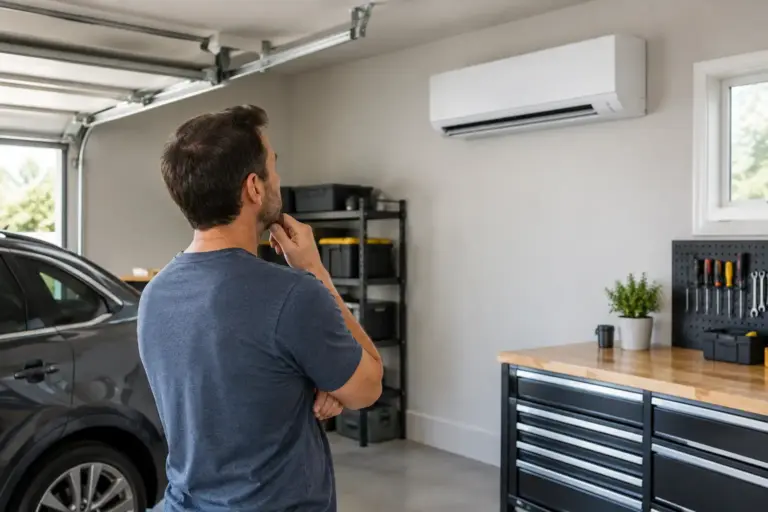

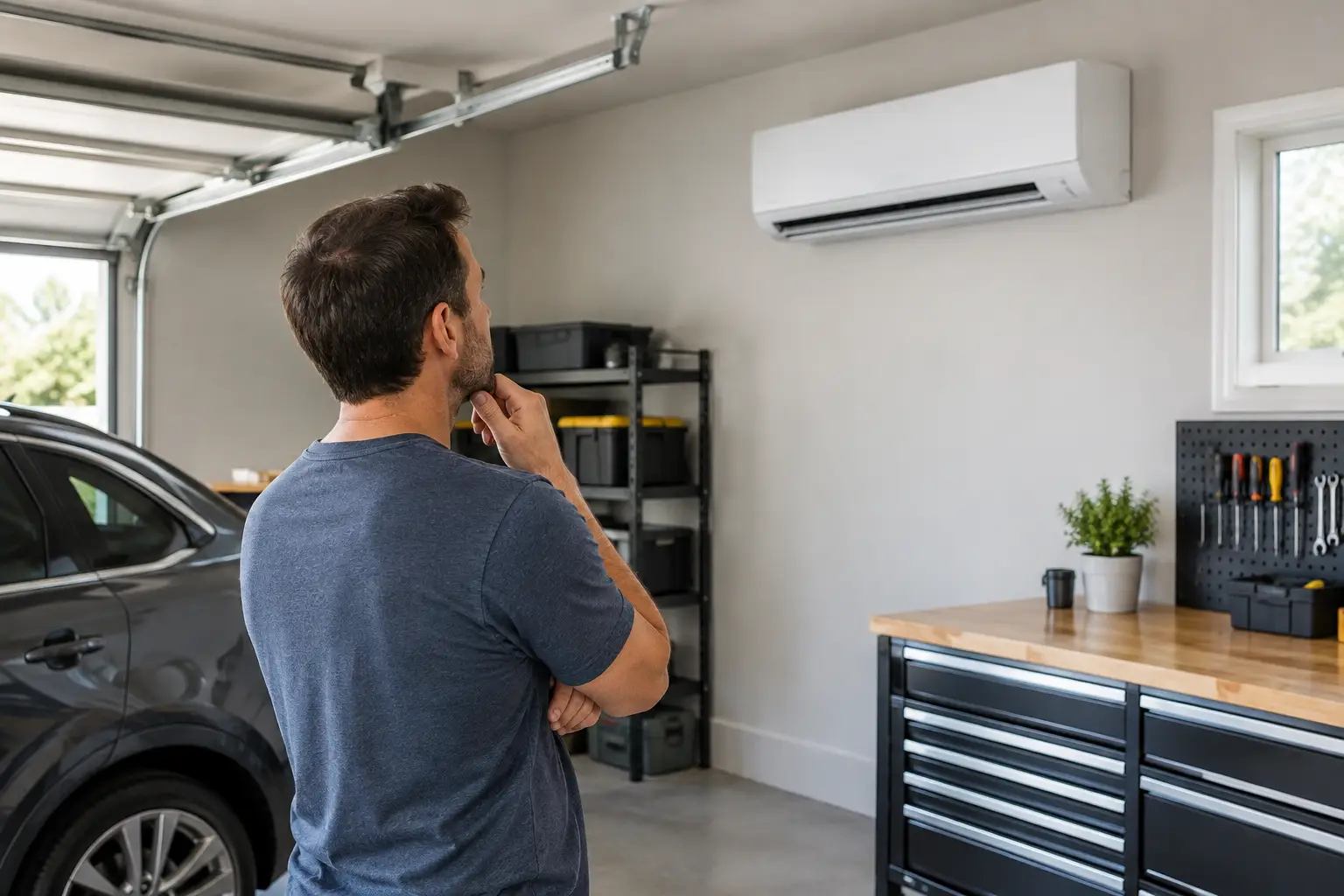
A garage can become the hottest room on the property long before the rest of the house feels uncomfortable. Concrete holds heat, metal doors radiate it inward, and many garages have little insulation or airflow. A mini split for garage cooling can solve that problem without extending existing ductwork, but only when the space, electrical capacity, insulation, and equipment size are evaluated honestly.
For a workshop, home gym, converted office, hobby room, or frequently used parking space, ductless cooling can make the garage usable through a Southern California summer. It is not automatically the right answer for every garage, though. The best installation starts with understanding what is driving the heat and what you expect the system to do.
Why Garages Are So Difficult to Cool
Most garages were not built as conditioned living spaces. They often have uninsulated garage doors, exposed walls, a hot roof or attic above, air gaps around the door, and a slab that releases stored heat well into the evening. Add a car that has just come off a hot road, power tools, lighting, or a refrigerator, and the cooling load climbs quickly.
That is why a system that seems properly sized by square footage alone can struggle. A 400-square-foot garage with poor insulation and direct afternoon sun may need more cooling capacity than a similarly sized bedroom. The goal is not simply to make the air feel cooler for 10 minutes. It is to maintain a reasonable temperature without forcing the equipment to run at full output all day.
Before recommending equipment, a qualified HVAC technician should look at the garage door, ceiling height, insulation, sun exposure, windows, wall construction, and how the room will be used. A garage used occasionally for storage has very different needs from a conditioned workspace used every afternoon.
How a Mini Split for Garage Cooling Works
A ductless mini-split system has an indoor air handler mounted on a wall and an outdoor condenser installed outside the garage. Refrigerant lines and electrical wiring connect the two components through a small wall opening. The indoor unit circulates and cools the air directly in the garage, while the outdoor unit releases the heat outside.
This setup avoids the need to add ducts to a space that probably has none. It also gives the garage its own temperature control, so cooling the garage does not require running the whole-home system harder. Many modern mini splits use inverter-driven compressors, which can adjust their output instead of repeatedly switching fully on and off. That can improve comfort and efficiency when the system is correctly sized.
A mini split also provides heating, which can be useful on cool winter mornings in the Valley or foothill communities. Still, cooling is usually the main concern for garages in the Los Angeles area, particularly where the space gets heavy afternoon sun.
Start With the Garage, Not the Equipment
It is tempting to choose a unit based on a quick online square-footage chart. Those charts can be a starting point, but they cannot account for the conditions that make garages challenging. Oversizing and undersizing both create problems.
An undersized unit may run continuously without reaching the set temperature on the hottest days. An oversized unit may cool the air too quickly, cycle inefficiently, and leave uneven temperatures in a poorly sealed space. It can also cost more than necessary upfront.
For many one- or two-car garages, systems in the 9,000 to 18,000 BTU range may be considered, but that is not a sizing recommendation by itself. A well-insulated 350-square-foot garage can have very different requirements than a 600-square-foot garage with a west-facing door, high ceiling, and no insulation. Proper load calculations and an on-site assessment are worth more than a guess based on floor area.
Insulation and Air Sealing Matter
Installing a mini split in an uninsulated garage is possible, but improving the enclosure first often delivers better comfort for the money. An insulated garage door, weatherstripping, ceiling insulation, and sealed gaps can reduce the amount of heat entering the space. These improvements help the mini split maintain temperature with less effort.
If the garage door opens constantly, expectations should also be realistic. Every time a large door opens on a 95-degree day, hot air enters quickly. The system can recover, but it cannot prevent that heat exchange. For a working garage with frequent vehicle traffic, cooling may be best viewed as comfort support rather than precise room-temperature control.
Installation Details That Should Not Be Overlooked
A clean mini-split installation is more than mounting an indoor unit and turning it on. The line set needs proper routing and protection, the condensate drain needs a reliable path, and the outdoor unit needs adequate clearance for airflow and service. Poor placement can create water issues, noise concerns, restricted performance, or an installation that simply looks unfinished.
Electrical capacity is another key point. Many garages need a dedicated circuit for a new mini split. A technician should verify the panel capacity and coordinate the necessary electrical work rather than assuming an existing outlet or circuit can handle the load. Local permit requirements may also apply depending on the scope of work and property location.
Indoor unit placement affects comfort. The air handler should be positioned to throw air across the garage rather than directly into a corner or behind shelving. In a long or unusually shaped garage, one wall-mounted unit may not distribute air evenly. In those cases, equipment selection and placement deserve extra attention.
Outdoor unit placement matters too. It should be protected from unnecessary damage, but it cannot be boxed into a tight area with poor ventilation. It also needs to be installed on a stable pad or properly designed wall bracket. A thoughtful installation protects performance and makes future maintenance much easier.
When a Garage Mini Split Makes Good Sense
A mini split is often a strong fit when the garage serves a regular purpose beyond vehicle storage. Homeowners who use the space as a workshop, fitness area, studio, hobby space, or home office generally benefit most because they are spending enough time there to value consistent comfort.
It can also make sense for property managers or business owners with small detached work areas, storage rooms, or light-duty operational spaces that need independent temperature control. The application needs to be evaluated carefully, especially if the space contains equipment that produces heat or has ventilation requirements separate from comfort cooling.
It may not be the best investment for a garage used only a few times each month. In that situation, insulation improvements, shade, ventilation planning, or a different comfort strategy may provide a more practical result. An honest recommendation should account for how often the garage is occupied, not just the appeal of adding new equipment.
Operating Costs and Maintenance Expectations
The cost to operate a mini split depends on the system size, efficiency rating, insulation, thermostat setting, outdoor temperature, and how often the garage door opens. A high-efficiency unit in a sealed, insulated garage will generally cost less to run than a larger system trying to cool a heat-soaked, leaky space.
A reasonable thermostat setting also helps. Trying to maintain 68 degrees in a garage during a triple-digit heat spell puts a much heavier demand on the system than maintaining a comfortable 76 to 78 degrees. The latter is usually a more realistic target for a working garage and can reduce unnecessary energy use.
Like any air-conditioning equipment, a mini split needs routine maintenance. Filters should be kept clean, the outdoor unit should remain clear of debris, and the system should be checked periodically for drainage, electrical connections, refrigerant performance, and overall operation. Neglecting maintenance can lead to reduced airflow, water leaks, higher utility costs, and avoidable wear.
Get a Recommendation Based on Your Actual Garage
The right answer is not always the largest mini split or the lowest quoted installation price. It is the system that matches the garage’s heat load, layout, use, and electrical conditions, installed cleanly and explained clearly. Ask for straightforward options, including whether insulation or air sealing should be addressed before equipment is selected.
For homeowners and businesses in Burbank, the San Fernando Valley, and nearby Los Angeles communities, Honest Heating & Air Conditioning can evaluate the space and explain practical options without pressure. A well-planned garage cooling system should make the room more useful when you need it most, while keeping long-term operation and maintenance manageable.